

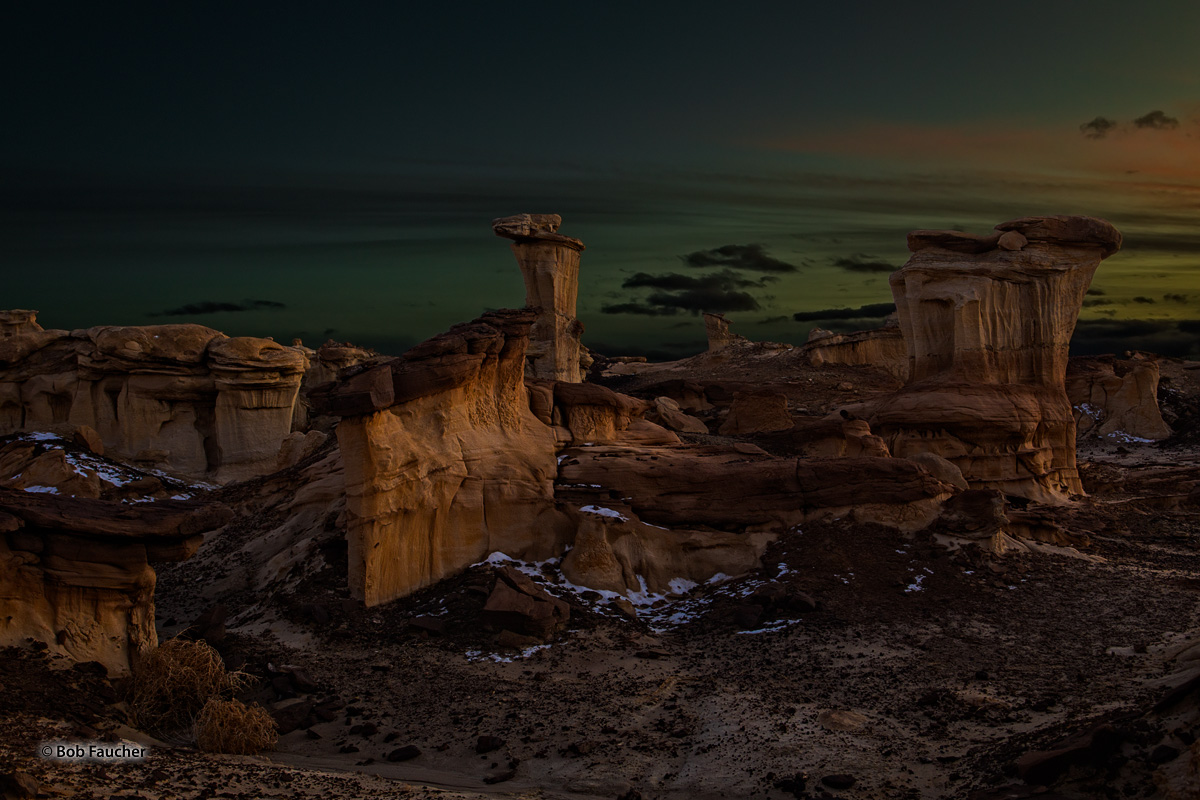

Nautical Twilight
New Mexico
The human eye finds it difficult, if not impossible, to discern traces of illumination during Nautical Twilight without artificial light, e.g. flash or using an earlier image to capture the foreground structures, provides an opportunity to merge the two images (exposure stacking) to provide some details in the foreground. The green nightglow seen here is chemiluminescence. Sunlight deposits energy into the atmosphere during the day, some of which is transferred to oxygen molecules. This extra energy causes the oxygen molecules to rip apart into individual oxygen atoms. This happens particularly around 100km in altitude. However, atomic oxygen isn't able to get rid of this excess energy easily and so acts as a 'store' of energy for several hours. Eventually the atomic oxygen does manage to 'recombine', once again forming molecular oxygen. The molecular oxygen then releases energy, again in the form of light. In reality, the green nightglow isn't particularly bright, it's just the brightest of all nightglow emissions. Photo © copyright by Robert Faucher.